
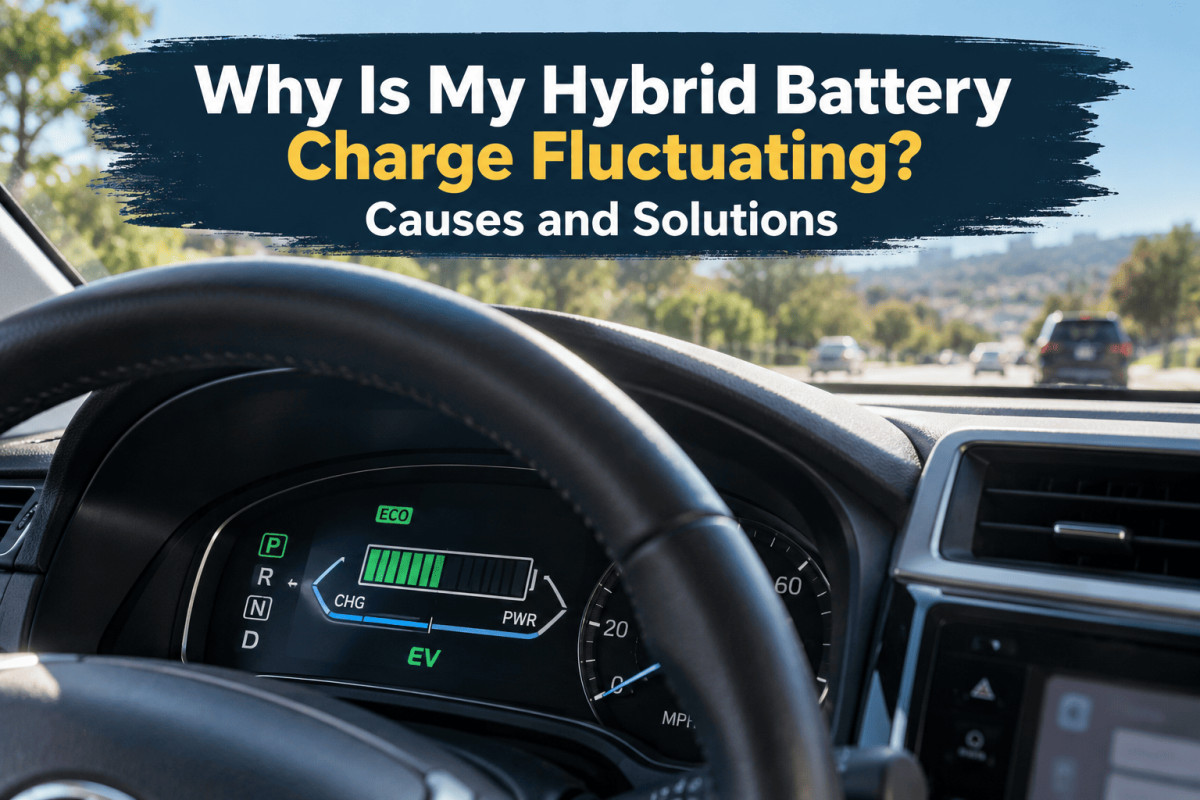
If you drive a hybrid vehicle, you may notice that the battery charge level increases and decreases frequently while driving. In many cases, this is completely normal. Hybrid vehicles automatically manage battery power to improve fuel efficiency, support acceleration, and keep the hybrid system operating efficiently.
However, if your hybrid battery charge is fluctuating unusually, your vehicle may have a battery health issue, a cooling problem, or another hybrid system fault that requires professional diagnosis.
Understanding the difference between normal battery behavior and potential warning signs can help you determine when your hybrid vehicle needs attention.
Is It Normal for a Hybrid Battery Charge Level to Go Up and Down?
Yes. In the majority of hybrid cars, a change in the level of battery charge is a normal phenomenon while driving. The process of energy management in a hybrid car takes place by means of the hybrid control system using energy of the gasoline engine, the electric motor, and regenerative brakes.
For instance, the charge of the battery may become higher in case of slowing down the car or braking due to the fact that the kinetic energy transforms into electric one by the regenerative braking system. The charge of the battery can decrease if the motor helps the gasoline engine during accelerating and if the car moves in the electric mode.
Normal variations in hybrid battery charge may happen when:
- You accelerate the car from a stationary position.
- You brake or decelerate the car in traffic.
- You drive uphill or move the car at high speeds.
- The gasoline engine charges the hybrid battery.
- The car alternates between electric and gasoline modes.
These changes are part of normal hybrid operation. The battery display is an estimate of the battery’s state of charge, not necessarily a direct indication of battery damage.
1. Regenerative Braking Can Increase Battery Charge
Regenerative braking is one of the major factors behind any changes in hybrid battery charge when driving.
During deceleration, the electric motor may function as a generator and convert some of the vehicle kinetic energy into electrical energy, which is stored in the hybrid battery for future use.
One might observe increased battery charge when going down a slope, approaching traffic lights, or braking while driving in heavy traffic.
Energy recovery depends on various factors including the driving situation, battery capacity, temperature, and vehicle systems.
Although regenerative braking does not recover all the energy spent on moving the vehicle, it can increase its efficiency.
Worry about: If there are any considerable changes in regenerative braking efficiency or if the warning lights come on, then one should have the car checked to find out the cause of the problem.
2. Acceleration and Driving Conditions Affect Battery Levels
Your hybrid car battery supplies extra power during acceleration and when the vehicle needs more help from the electric motor.
When accelerating rapidly, driving uphill, or at faster speeds, the charge level of the battery may go down as the electric motor will utilize the stored energy. Once there is less need for it, the battery levels can be replenished by the gas engine and regenerative braking.
So frequent changes in the battery charge can be considered normal, especially in busy traffic or with hills.
But if the battery charge level goes down too quickly while driving normally, switches rapidly between extremely high and low levels, or if there is a lack of performance, you might want to check it out.
That all depends on the specifics of your car.
3. Battery Degradation Can Cause Unusual Charge Fluctuations
With time, hybrid batteries become less capable of storing and delivering energy. This phenomenon is called hybrid battery degradation.
When the hybrid battery capacity decreases, the vehicle will have to charge and discharge its battery more often in order to comply with your driving needs. The charging levels displayed by the vehicle therefore will start changing more often than before.
Indications of hybrid battery degradation can be as follows:
- Unusually fast changes of battery charge levels;
- Lower fuel efficiency than usual;
- Higher frequency of the gasoline engine running;
- Less assistance from the electric motor;
- Presence of any warning lights or DTCs related to the hybrid system.
However, these indications do not always mean that your hybrid battery needs to be replaced, since other parts or driving conditions might lead to the same effects.
Only an expert assessment of the state of your hybrid battery can show whether your battery has degraded and what should be done about it.
4. Hybrid Battery Cooling Problems Can Affect Performance
The charging and discharging process of hybrid batteries results in the formation of heat. There are many hybrid cars that have a special cooling system to maintain optimal temperature for the battery to operate.
Any kind of restriction in airflow, a dirty or malfunctioning fan, or some other issue related to the cooling system can lead to the heating of the battery.
Excessive temperature of the battery can result in the restriction of the capacity of the battery by the vehicle’s control system.
There are possible signs like unusual noise from the cooling fan, hybrid system issues, poor performance, or any abnormalities in the battery.
It is important to maintain the battery cooling vents as per the manufacturer’s instructions. Do not try to fix any issues with the cooling system without checking it first since the high voltage can be dangerous.
5. Other Hybrid System Problems May Affect Charge Levels
Hybrid battery is just one component in a bigger system where sensors, electrical components, battery management system, inverter and many others play the role of regulation of the power distribution.
Fault in a sensor may give false data on the battery. Electrical and inverter systems’ malfunction may cause problems in distributing power from the battery to the motor and others.
Since there could be more than one fault that can cause similar symptoms, the battery replacement without thorough testing can lead to unnecessary costs.
In case your hybrid car gives out warning lights, goes into a low-power mode, has sudden performance changes, book an inspection. In case the car gives you a warning light for a severe problem in hybrid system or brakes, park the car in a safe place and follow the manufacturer’s instructions.
6. How Do Professionals Diagnose Hybrid Battery Charge Fluctuations?
Professional hybrid system diagnosis is performed on the vehicle itself rather than on just the battery monitor.
Depending on the vehicle and the problem, the test may include:
- Scanning trouble codes: Reading the diagnostic trouble codes in the vehicle’s computer related to battery, inverter, sensors, and hybrid system problems.
- Analyzing battery data: Analyzing any state-of-charge data, battery temperature information, and battery block/cell data available for the specific battery.
- Checking cooling components: Examining the battery cooling fan, airflow paths, and other cooling components.
- Determining battery system performance: Deciding if the battery and battery components are performing to manufacturer specifications.
- Deciding on the proper repair: Identifying whether the problem requires maintenance, a repair, more testing, or battery replacement.
The test can vary by manufacturer and model. An accurate test will help differentiate between normal battery charge fluctuations and a problem that needs repair.
Frequently Asked Questions
Why does my hybrid battery go from full to low so quickly?
Fluctuations may happen due to the reasons like acceleration, regenerative braking or natural battery operations. In case the rate is untypically high or there are other symptoms, get your car inspected.
Can a weak hybrid battery still drive the car?
It is possible to drive a car with a bad hybrid battery in certain cars, though the performance may become worse. Your car may go into a limited power mode or show messages on the dashboard. Do not ignore the problem, have the battery checked.
Does a fluctuating hybrid battery mean it needs replacement?
Not necessarily. Fluctuations of the charge do not mean that the battery should be replaced. Professional service will help you to evaluate the battery and make appropriate recommendations.
How can I help maintain my hybrid battery?
Ensure that you follow the maintenance guide from the manufacturer, clean battery cooling vents as recommended, and act on warning lights. Don’t ignore consistent changes in performance.
Conclusion: Get Expert Hybrid Battery Diagnostics from Tip Top Hybrid
A hybrid battery charge level that goes up and down is often a normal part of hybrid vehicle operation. Regenerative braking, acceleration, and the vehicle’s energy management system all contribute to these changes.
However, unusually rapid fluctuations, declining fuel economy, warning lights, or reduced performance may indicate battery degradation, cooling problems, or another hybrid system fault. Professional diagnostics can help identify the cause and determine the most suitable solution.
If you’re looking for a Hybrid Battery Repair & Replacement Expert in Southern California, consider Tip Top Hybrid. Our specialized hybrid services include hybrid battery diagnostics and repair, battery replacement, inverter service, and high-voltage system diagnostics.
Whether your hybrid battery charge is fluctuating unexpectedly or your vehicle is showing other warning signs, a proper evaluation can help you understand your repair options.
Visit Tip Top Hybrid to learn more about our hybrid battery repair and replacement services and request an estimate for your vehicle.
Tip Top Hybrid is your local resource for specialized hybrid battery repair and replacement in Southern California.