
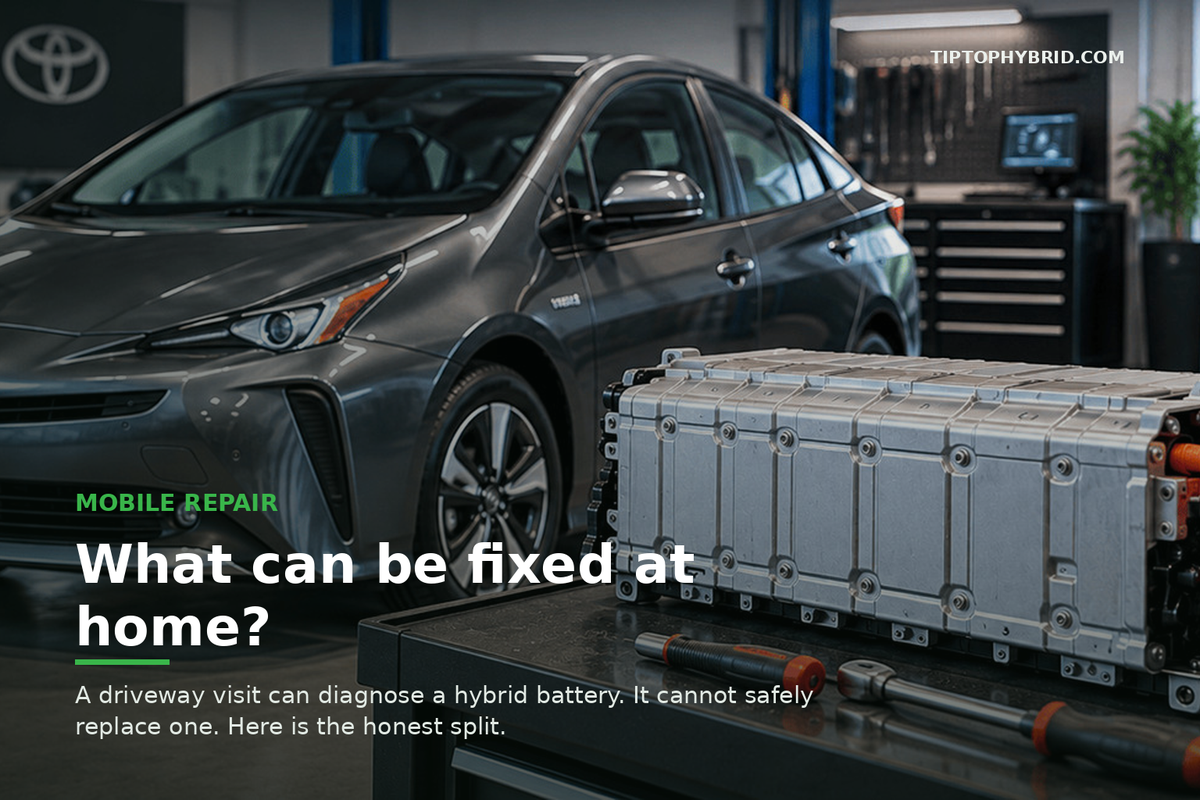
Most hybrid battery work cannot happen in your driveway. A mobile tech can scan codes, read block voltages and check cooling airflow. A pack swap is possible if the provider stocks the pack and carries high-voltage gear. Module balancing, isolation testing and inverter work need a shop bay.
Tip Top Hybrid is a shop in Upland, and high-voltage work belongs in a bay. This page answers the question straight, because most of what ranks for it is sales copy.
What a Mobile Tech Can Do at Your Curb
A driveway visit is useful for one thing: finding out what is wrong. Most of the tools for that fit in a case.
| Task | At your home? | Why |
|---|---|---|
| Read hybrid codes and freeze-frame data | Yes | Plugs into the OBD-II port, ten minutes |
| Block voltage readout | Yes, with a charge cycle | Same port, but the numbers only mean something after a drive or forced charge |
| 12V battery load test | Yes | Hand-held tester, two minutes |
| Cooling fan and intake inspection | Yes | Visual check plus a fan command test |
| High-voltage cable and connector check | Visual only | Isolation testing needs a meter, a dry bay and a written procedure |
| Pack removal and swap | Sometimes | Only with a provider that stocks the pack, carries Class 0 gloves and has done it before |
| Module replacement and balancing | No | Pack on a bench, matched modules, hours of load testing |
| Inverter, coolant pump, cooling system repair | No | Coolant, a lift, and high-voltage lockout |
| Leak test and isolation fault chase | No | Dry bay, megohmmeter, controlled conditions |
Everything above the pack removal line is diagnosis. Everything below it is repair.
What Needs a Shop, and Why
High-voltage isolation faults
When the car logs an isolation fault, voltage is leaking to chassis somewhere in the pack or its cables. Finding it means disconnecting sections, testing with a megohmmeter and keeping the area dry. A damp driveway changes the reading. This is a bay job with a procedure.
Anything that needs a lift
A hybrid pack weighs 80 to 120 pounds depending on the model, and on several cars it drops out from below. That needs a lift, a transmission jack and two people. Lying under a car on a sloped driveway with a battery over your chest is how people get hurt.
Module balancing and matching
A real recondition means discharging the pack, testing each module under load, matching replacements to the strong modules and cycling the rebuilt pack before it goes back in. That is six to twelve hours on a bench that does not travel.
Cooling and leak testing
The pack depends on a fan, ducts and an intake behind the rear seat. When an inverter water pump or the coolant circuit is involved, you need a pressure test and a vacuum fill. Doing that in a driveway in August is how air gets into a cooling system.
Five Checks Before You Book a Mobile Visit
A little preparation decides whether the visit works.
- Level, legal parking. A sloped driveway or a soft shoulder is a no. So is a spot where the tech works in traffic.
- Permission in writing. HOAs, apartment managers and street permits all get awkward when a van with jacks arrives.
- Weather and daylight. High-voltage work in rain is not happening, and neither is a swap in a dark carport.
- Access to the pack. Empty the cargo area and rear footwells. Ten minutes of your time saves half an hour of billed time.
- Written scope and warranty. Ask what happens if the job cannot be finished on site, and who pays the second visit.
Mobile vs Shop: What the Numbers Actually Look Like
Mobile service does not make a pack cheaper. What changes is travel, towing and how many visits it takes.
Published California rate cards from November 2026 give a realistic picture. One operator advertises installation included with the pack and a 30-minute appointment. Another publishes travel fees by distance: nothing inside its service city, $25 up to 25 miles, $50 to 50 miles, $75 to 75, $100 to 100, then a dollar a mile beyond. Reconditioned packs installed there commonly land at $900 to $1,800, the same band an independent shop charges.
| Situation | Mobile, all-in (typical 2026) | Shop, all-in (typical 2026) | Better call |
|---|---|---|---|
| Confirmed dead pack, easy driveway access | $900–$1,900 with travel | $900–$1,800, plus a tow if it will not drive | Mobile, if the diagnosis is already certain |
| Warning light, cause unknown | $75–$150 diagnostic, then a second visit | $75–$150 diagnostic, repair the same day | Shop, because the answer decides everything |
| Car will not start or will not enter READY | Rarely helps, still needs a tow | $100–$250 local tow plus diagnosis | Shop |
| One weak module, rest of pack healthy | Not offered | $400–$900 | Shop |
The short version: mobile wins on logistics, not price. If you know the pack is dead and the car sits somewhere a van can reach, a driveway swap is reasonable. With a warning light and no diagnosis, paying someone to guess costs more than driving to a shop that can finish the job.
If Your Hybrid Won't Start in Upland, Montclair, Claremont or Pomona
Most expensive mistakes happen in the first hour, before the car moves.
- Stop cranking. Repeated attempts drain the 12V and can flood a cold engine.
- Watch the dash. If it stays dark, that points to the 12V or a connection, not the traction pack.
- Test or charge the small battery first. Plenty of "my hybrid died" calls are a five-year-old 12V battery.
- Photograph the dash and any message on the screen. That photo is worth more to a tech than a phone description.
- Don't let a tow take it to a dealer before someone reads the codes. Once it is on the lot, you lose the choice.
Local detail changes the advice. A car that quit on the 10 shoulder in August needs a safe tow first, and that cab gets hot enough to finish off a marginal pack. Driveways in the Claremont foothills run steep, so chock the wheels and stay out from under. Montclair apartment garages often have clearance a service van cannot manage, and street parking in Pomona can need a permit. All of which is a reason to move the car, not the toolbox. If you are stuck, read Prius not starting but dashboard lights are on, then call us.

How to Vet a Mobile Hybrid Provider
The barrier to entry is a van, a website and a supplier, which is not the same as being qualified.
- License and registration. California repair shops and technicians must be registered with the Bureau of Automotive Repair. Check the business before you book, using the BAR consumer resources, which also explain your right to a written estimate.
- Insurance. Ask for a certificate covering general liability and customer vehicles. A one-van operation without it is a gamble you fund.
- High-voltage training and gear. Ask what gloves they use. Class 0 rated gloves, a lockout procedure and a properly rated meter are the minimum.
- Warranty terms in writing. Parts only or parts and labor, for how long, and who honors it if the company is 400 miles away.
- What they refuse to do. "We swap packs, we don't rebuild them in your driveway" is an honest answer. A promise of module-level repair on the street is not.
One free test: ask what happens if the new pack does not clear the code. A straight answer involves a scan and a refund conversation.
Common Questions About Mobile Hybrid Repair
Can a hybrid battery be replaced at my home?
Yes, on some cars, by some providers, when the fault is confirmed, the pack is in stock and the car is parked somewhere flat and accessible. You cannot count on it for every model.
What can a mobile technician actually check?
Codes, live data, block voltages after a charge cycle, the 12V battery, fan operation, intake airflow and visible cable condition. That is enough to tell whether you need a pack, a module or a cooling repair.
How much does a mobile hybrid diagnostic cost?
Typically $75 to $150 in Southern California as of November 2026, sometimes credited toward the repair. One Bay Area shop publishes $65 for a standard scan and $135 for a deep scan, and dealers commonly charge $100 to $250.
Is it safe to have hybrid battery work done in my driveway?
A scan, yes. Pack removal is safe only with the right gear, flat ground and a trained tech. High-voltage work in rain, on a slope or in a shared carport is where it stops being safe, whoever holds the wrench.
What should I do if my hybrid won't start at home?
Leave the ignition alone, check whether the dash lights up, test the 12V battery, photograph the dash, and call a hybrid shop before you call a tow.
When It Needs a Bay, Bring It to Upland
Pack removal, module work, isolation testing and cooling repair all happen here. Call 909-238-7028 and describe what the dash is doing, or contact the shop with your year, model and mileage. If the car still drives, drive it in. If it does not, we will tell you what to check before you pay for a tow. There is more on our hybrid battery repair and replacement page, or you can start with a free estimate.
Tip Top Hybrid, 1894 W 9th St Ste B, Upland, CA 91786. Hybrid battery repair and replacement in Upland, serving the Inland Empire.