
Which Battery Is Failing? The 45-Second Answer
Two batteries, two jobs. The 12V wakes the computers and closes the high-voltage relays. The traction pack stores energy and spins the engine. Dim lights and a no-start mean the 12V. P0A80, a red triangle and falling MPG mean the pack. Test the 12V first.
Both feel identical from the driver's seat: no READY, warning lights, a car that won't move. One fix is a couple hundred dollars. The other is four figures.
What Does the 12V Battery Actually Do in a Hybrid?
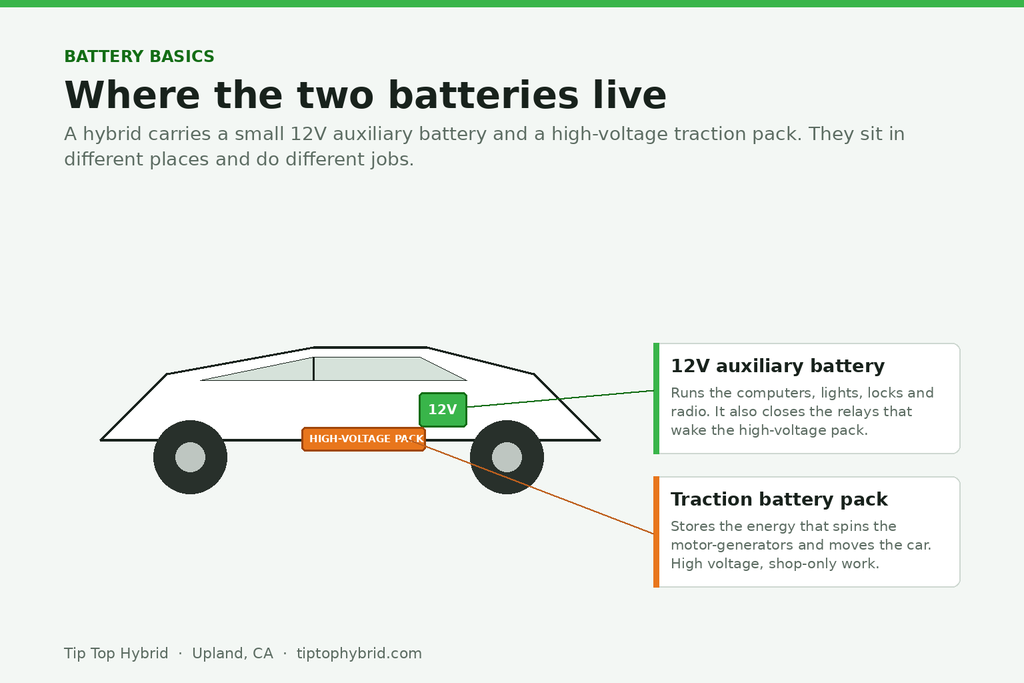
It runs everything except the wheels. Door locks, radio, headlights, the dash, the computers that decide whether the car may start. On a Toyota or Lexus hybrid it also energizes the relays that connect the big pack to the inverter. That click when you press the button is those relays closing.
What it does not do is crank the engine. Plenty of generic battery advice gets this wrong. There's no starter motor bolted to the flywheel. Motor-generator one, fed by the high-voltage pack, spins the engine through the power split device. The 12V gives the system permission.
It's a small lead-acid or AGM battery. On a Prius it hides in the trunk or under the rear floor. On some hybrids it's in the engine bay. Either way it's smaller than a gas-car battery, because it isn't dragging a cold engine around.
The voltage numbers that give it away
You can learn a lot with a $30 multimeter, as long as you read it in the right state. These are typical numbers for a 12V auxiliary battery in a hybrid:
| Reading | What it means |
|---|---|
| 12.6V, car off, settled overnight | Fully charged and healthy |
| 12.2V, car off | Roughly half discharged — either it wasn't charged or it's losing capacity |
| Below 12.0V, car off | Weak. Expect a no-READY morning soon |
| 13.7–14.5V with the car in READY | Normal. The DC-DC converter is charging it |
| Under 10V during a load test | Failing, even if it reads fine at rest |
One catch: in READY you'll never see 12.6V, only charging voltage. Read 12.4V at the terminals with the system live and the battery isn't taking a charge, or the converter isn't feeding it.
A battery can hold 12.6V at rest and still fall on its face under load, which is why a conductance tester beats a $30 meter. Midtronics has a plain-English guide to battery testing methods.
What Does the High-Voltage Pack Do That the 12V Can't?
The traction battery stores the energy that moves the car. On most Toyota and Lexus hybrids it's a nickel-metal hydride pack of around 200 volts nominal, built from modules wired in series. Newer lithium packs sit higher. The number on the label is nominal, not what you'll read live.
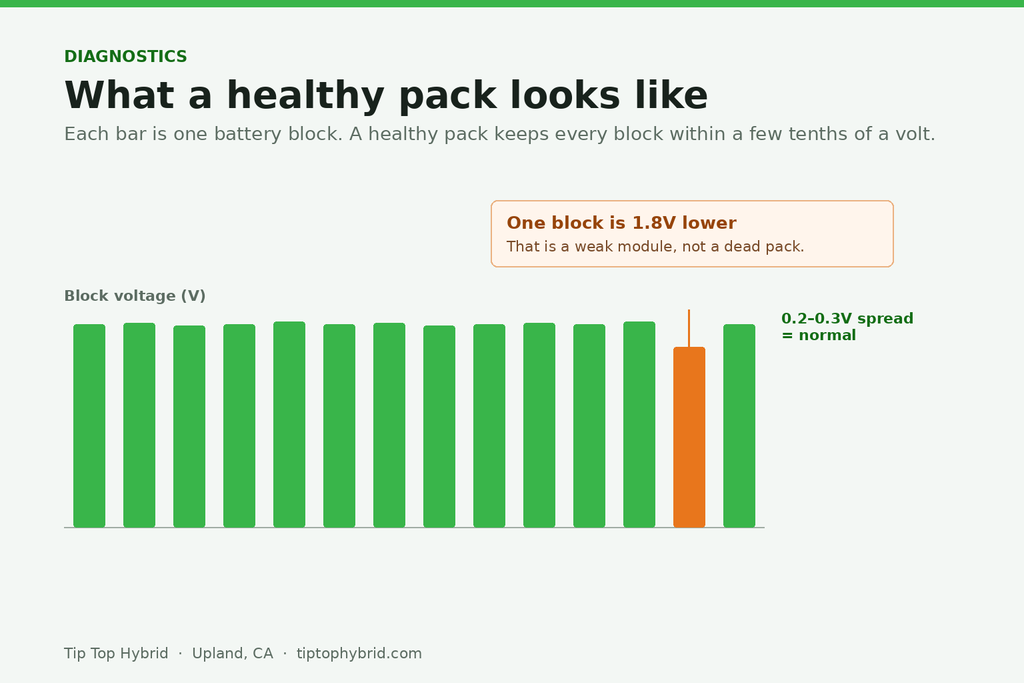
Inside, cells are grouped into blocks. A scan tool shows those blocks as a row of voltages, usually 14 of them on a Prius, each around 14 to 16 volts. That row is the most useful diagnostic view on the whole car. When one block drifts away from the others, the pack is telling you something the dashboard won't.
A battery management system watches temperature, voltage and current, balances the blocks, and sets codes when the numbers stop making sense. It's conservative on purpose. It will cut electric assist and force the engine on rather than let a hot pack take more load.
Because the pack spins the engine, a dead traction battery also means no start. That's why "my hybrid won't start" is not automatically a 12V problem.
Match the Symptom to the Battery Before You Buy Anything
Start with the symptom, not the suspicion. Our order of work:
| Symptom | More likely battery | First test | Typical fix |
|---|---|---|---|
| No READY, dash dim, doors slow to unlock | 12V | Voltage at rest, then conductance test | Replace the 12V |
| No READY, but lights and radio are bright and normal | Either — check both | Code scan, then 12V, then block voltages | Depends on codes |
| Starts fine, then dies or refuses to restart after a short trip | 12V, often a charging or draw fault | Charging voltage in READY, then parasitic draw | Battery, DC-DC fault, or a draw |
| Red triangle plus P0A80 | Traction pack | Block voltage spread under load | Module repair or pack replacement |
| MPG down 5 or more, engine runs constantly | Traction pack or cooling | Block voltages, pack temperature, fan command | Cooling service, repair, or replacement |
| Battery gauge drops fast under load, then recovers | Traction pack | Block voltages at mid charge | Weak module identified |
| Warning lights after a jump start | 12V first, then recheck | Clear and re-scan after a full charge | Often clears once the 12V is healthy |
Five Signs Your 12V Is the Problem, Not the Pack
A hybrid 12V fails quietly because nothing cranks. No labored start warns you. You get electrical weirdness instead:
- Your clock and radio presets reset, or the trip meter zeroes itself.
- Keyless entry takes two or three presses, or the fob only works up close.
- The dash flickers or dims when you press the start button.
- The rear hatch release gets lazy, or the interior lights glow dim.
- "Check Hybrid System" appears right after someone jump-starts you.
That last one scares people into thinking the pack is gone. Usually it isn't. Low voltage makes the hybrid ECU see data from modules that aren't awake, and it logs faults. Fix the 12V, clear the codes, drive it, see what returns.
When the Red Triangle and P0A80 Point at the Pack
P0A80 means "replace hybrid battery pack." Read that literally and you'll spend thousands. Read it the way a tech does and it means the pack failed a self-test. The reason could be one weak block, a bad connection, or a cooling problem that cooked a section of the pack.
The code is a conclusion the computer reached, not a diagnosis. We've seen packs quoted on P0A80 alone when a block-voltage log would have shown thirteen good blocks and one bad one. That's a repair, not a replacement. Here's the full breakdown of what the P0A80 code means and what to do next.
Other pack symptoms are slower and easier to miss. Fuel economy sliding from 48 to 38 over a few months. The gauge dropping two bars on a mild hill. The engine running at stoplights when it used to shut off. None of these proves a pack is dying. Together, they're worth an hour on a scan tool.
And if you're driving with a red triangle and telling yourself it's fine, the cost of waiting is real. Ignoring a hybrid battery warning light rarely ends with the light going away on its own.
What Each Replacement Costs in 2026 (and Why the Gap Is So Wide)
Typical market ranges, not a quote from us. Prices checked November 2026.
| Replacement | Typical independent shop | Typical dealer | Notes |
|---|---|---|---|
| 12V auxiliary battery, installed | $180–$320 | $250–$450 | AGM costs more; some models need a relearn step |
| Traction pack, reconditioned or remanufactured | $1,500–$2,600 | Not usually offered | Depends on modules replaced and warranty |
| Traction pack, new OEM | $2,800–$4,500 | $3,500–$5,000 | Newer lithium packs and SUVs run higher |
| Used pack from a donor car | $900–$1,600 | — | Cheapest option, shortest warranty, highest risk |
The gap between dealer and specialist isn't labor. It's the part. Dealers fit new OEM packs. Independent shops fit remanufactured packs, replace modules, or source low-mileage units, each with its own warranty and risk.
A 12V swap is same-day. A pack replacement ties the car up one to two days.
If your pack tested bad, ask about repairing the pack instead of replacing it before you approve a four-figure quote. On a Prius with one weak block, it's often the better call.
Why We Put a Tester on the 12V Before We Touch the Pack
Order of operations is where money gets saved. Our sequence goes like this:
- Ask what the car is doing, and when it started.
- Scan all modules, not just the hybrid ECU. Freeze frame data shows what the car was doing when the fault set.
- Test the 12V with a conductance tester, not a glance at the voltage.
- Only then pull pack data: block voltages, temperature, state of health, fan command.
Skipping step three is the classic error. A weak 12V can set hybrid codes and cause a no-READY, making a good pack look guilty. We have seen packs quoted for replacement on codes that vanished once the auxiliary battery was healthy.
The reverse holds too. Swapping a 12V that keeps dying without checking for a parasitic draw means you'll be back in six months.
Safety, once: high-voltage work is shop-only. The pack holds enough energy to hurt you and stays live with the car off. Don't probe orange cables or pull the service plug to "have a look."
Where This Shows Up Around Upland and the Inland Empire
Most of the cars we see come from within fifteen miles: Upland, Montclair, Claremont, Pomona, Rancho Cucamonga. The driving pattern here is hard on 12V batteries. Three-mile school runs, a Costco trip, a commute down the 10 that never lasts long enough to recharge what starting took out.
Then summer arrives. Underhood heat in stopped traffic on a 100°F afternoon finishes off a battery that was already undercharged. We replace more 12V batteries in July, August and September than the rest of the year combined, and many are three to five years old. The pack gets the same heat plus dust, pulled from the cabin through a vent behind the rear seat that nobody vacuums.
Questions We Get at the Counter
Does a hybrid have a normal 12V battery?
Yes. It's a lead-acid or AGM battery, usually smaller than a gas car's, and on many Toyota hybrids it lives in the trunk or under the rear floor. Same chemistry, different job.
How do I know if it's the 12V or the hybrid battery that failed?
Look at the lights. A dim dash, slow locks and a no-start point at the 12V. Bright electrics with a red triangle and P0A80 point at the pack. When it's ambiguous, test the 12V first. It's fast and cheap.
What voltage should a hybrid 12V battery read?
About 12.6V at rest, car off and settled. Below 12.2V it's discharged; below 12.0V it's on borrowed time. In READY you should see 13.7V to 14.5V, which is the converter charging it.
Can a weak 12V battery trigger a "Check Hybrid System" warning?
Often, yes. Low system voltage makes modules drop offline or report data the hybrid ECU rejects, and it logs a fault for it. The giveaway is a cluster of unrelated codes that all clear once the battery is replaced and the car has been driven a few miles.
How much does each battery cost to replace in 2026?
A 12V installed runs $180 to $320 at an independent shop, $250 to $450 at a dealer. A traction pack is another scale: $1,500 to $2,600 reconditioned, $3,500 to $5,000 new at a dealer. Market ranges, November 2026.
Get Both Batteries Tested in Upland
One visit, both batteries tested, one straight answer about which is failing and what the fix costs. We do Toyota Prius hybrid battery service plus Camry, RAV4, Highlander, Accord and Lexus hybrids.
Call 909-238-7028 or request a free estimate in Upland. We're at 1894 W 9th St Ste B, Upland, CA 91786.
Tip Top Hybrid — hybrid battery repair and replacement in Upland, serving the Inland Empire.