
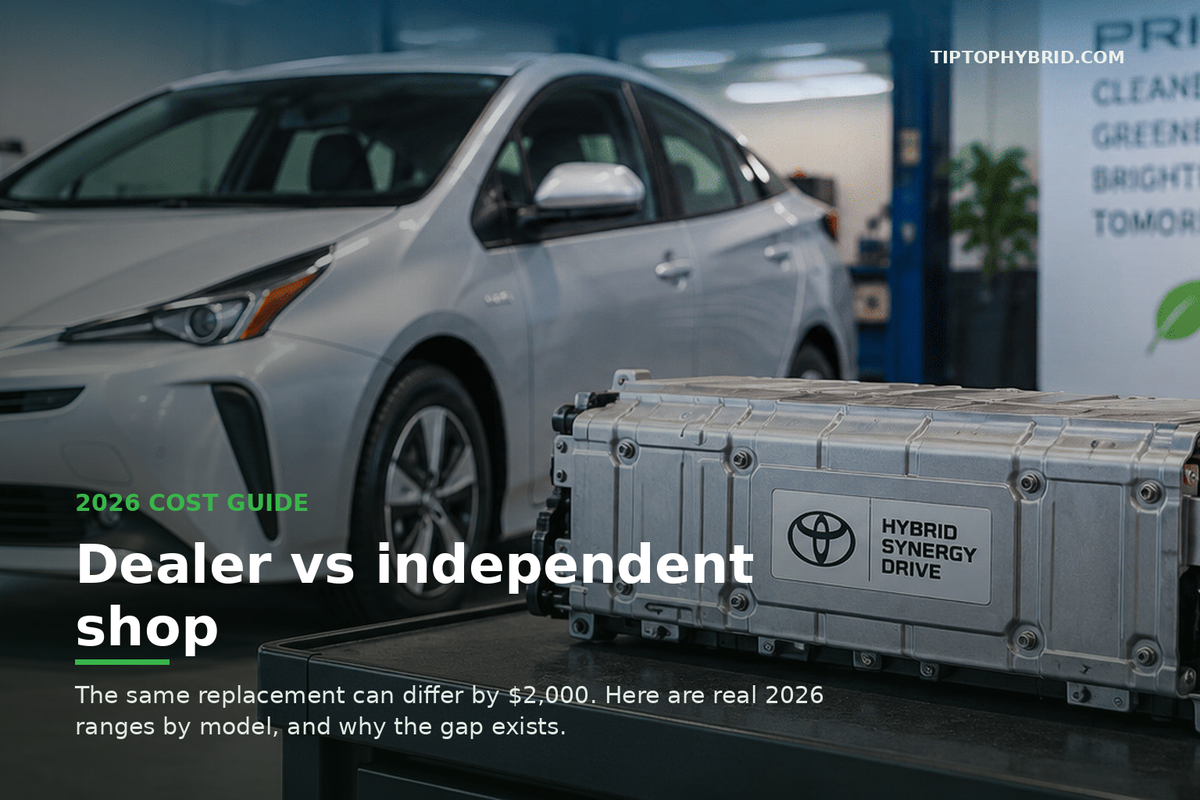
In 2026, a hybrid battery replacement typically costs $3,500 to $6,000 at a dealer and $1,400 to $3,000 at an independent hybrid specialist for the same car. A reconditioned pack installed runs about $900 to $1,800. A used pack runs $600 to $1,400. Most of that spread is parts markup, labor rate and warranty length, not better workmanship.
Prices checked November 2026. Market ranges, not quotes. Every figure here is a typical US installed range for battery plus labor, before tax. We re-check these quarterly, because pack prices move with supply.
The Short Answer: Four Ways to Buy the Same Repair
People compare a dealer quote to a shop quote and assume one is lying. Usually both are honest. They are quoting different products.
| Option | Typical 2026 installed range | What you get | Why the price sits there |
|---|---|---|---|
| Dealer, new OEM pack | $3,500–$6,000 | Factory pack, dealer labor, factory-backed warranty | New cells, dealer labor rate, parts markup and the longest paper trail |
| Independent hybrid specialist | $1,400–$3,000 | New OEM or tested remanufactured pack, hybrid-specific labor | Lower labor rate, aftermarket pack supply, shorter warranty |
| Reconditioned pack | $900–$1,800 | Your pack rebuilt with matched modules, or a rebuilt exchange unit | Reuses your housing and good modules; you pay for labor and test time |
| Used or salvage pack | $600–$1,400 | A pack pulled from another car, usually with unknown history | Cheapest part, no testing standard, shortest warranty or none at all |
The dealer row is the safest buy and not a rip-off. Most owners land on the independent row, where a tested remanufactured pack does the same job for roughly half. The bottom two rows are where people get hurt: a $700 quote with no test sheet and no written warranty is the one to walk away from.
Hybrid Battery Prices by Model, 2026
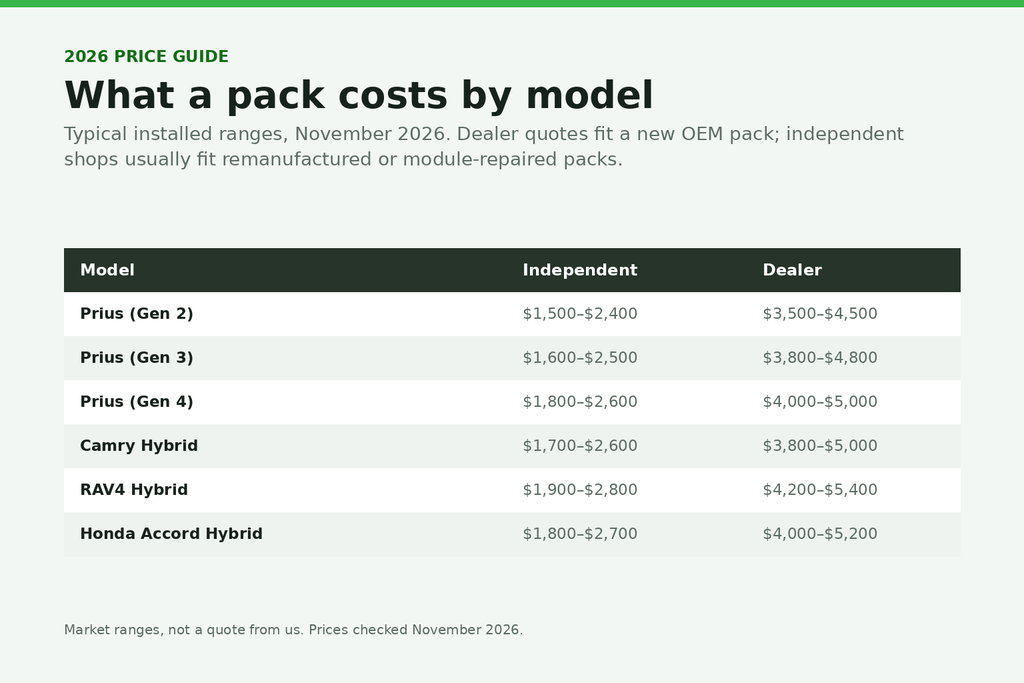
Model and generation move the number more than brand does. Pack size, cell count and how much trim comes out change the labor side. Aftermarket supply changes the parts side.
| Model and years | Dealer, new OEM (typical) | Independent specialist (typical) | What drives the difference |
|---|---|---|---|
| Toyota Prius Gen 2, 2004–2009 | $3,500–$4,500 | $1,400–$2,000 | Huge aftermarket supply, simple pack access |
| Toyota Prius Gen 3, 2010–2015 | $3,800–$4,800 | $1,500–$2,200 | Most common hybrid pack in the country, plentiful cores |
| Toyota Prius Gen 4, 2016–2022 | $4,000–$5,500 | $1,800–$2,800 | Lithium pack, fewer rebuilders, higher core value |
| Toyota Camry Hybrid, 2007–2024 | $4,200–$5,800 | $1,600–$2,600 | Larger pack, more rear trim work on sedans |
| Toyota RAV4 Hybrid, 2016–2024 | $4,500–$6,000 | $2,000–$3,000 | Crossover packaging, AWD versions take longer |
| Honda Accord Hybrid, 2014–2024 | $4,000–$5,500 | $2,200–$3,200 | Thinner independent supply, fewer rebuild options |
| Lexus CT 200h, 2011–2017 | $4,000–$5,200 | $1,700–$2,600 | Prius-family pack, Lexus labor rate |
| Lexus ES 300h, 2013–2024 | $4,500–$6,000 | $2,000–$3,000 | Bigger pack, more cabin disassembly |
Two warnings. High-mileage cars often price lower, because rebuilders care about core condition. And every number above assumes the pack is the problem. If the fault is a coolant pump or a seized fan, you are looking at hundreds, not thousands.
For the Prius, generation by generation with the warranty detail, our Prius battery replacement cost page goes deeper. This page stays brand-agnostic so the two don't repeat.
Why Two Quotes for the Same Car Differ by $2,000
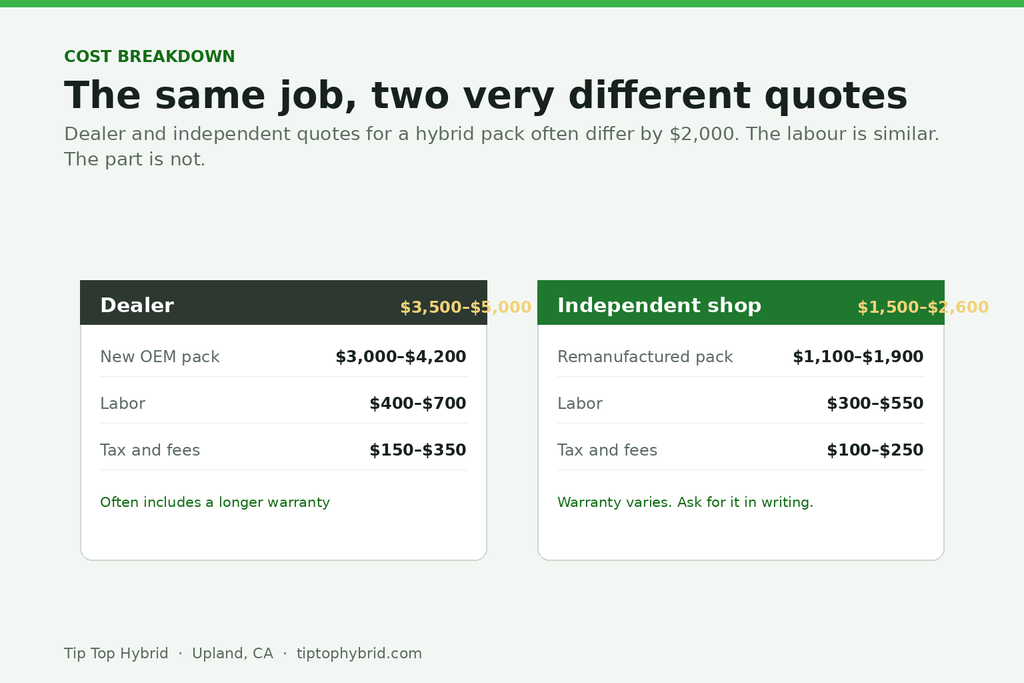
A $2,000 gap looks like somebody is padding a bill. It is four line items, and all four show up on an itemized estimate.
- The pack itself. A new OEM pack and a tested reconditioned pack can differ by $1,200 before anyone touches the car. That one choice explains most of the gap.
- Labor rate and hours. Dealers in Southern California commonly bill $180 to $250 an hour; independent hybrid shops commonly bill $110 to $160. On a four-hour book job that is a $400 to $600 swing.
- Diagnostics. A hybrid diagnostic typically runs $75 to $150 at an independent shop and $100 to $250 at a dealer. Some quotes fold it in, some bill it on top.
- Warranty. Parts-only for 12 months, parts and labor for 36, or a "lifetime" claim that covers only the part. You pay for that term whether the quote says so or not.
Then the small lines people miss: a core charge refunded only if you hand over the old pack, disposal, and sales tax on a bigger parts number at the dealer.
Owners have brought in a $4,900 dealer quote on a 2013 Prius and driven out on a tested reconditioned pack for well under half. Others have turned down a cheap salvage pack after seeing the block voltages, which was the right call. Price is the last thing to compare, and a firm quote that arrived before anyone read your block voltages is a guess with a number attached.
Five Things That Change Your Quote
Which Pack You Buy
This is the biggest lever and the one most owners rush. New OEM, remanufactured from matched modules, reconditioned from your own housing, and salvage are four products with four lifespans. A 2008 Prius worth $5,000 rarely justifies a $4,500 factory pack; a 2021 RAV4 with 60,000 miles usually does. Compare cost per year of remaining life, not sticker price.
Your Generation and Battery Chemistry
Nickel-metal hydride packs from the 2000s are cheap to rebuild because rebuilders know them cold and cores are everywhere. Later lithium packs are lighter, but fewer shops rebuild them and the modules cost more. That is why a Gen 4 Prius quote can sit $400 to $600 above a Gen 3.
Whether It's a Pack, a Module, or Something Else
Plenty of "bad battery" diagnoses turn out to be one weak module, a clogged cooling intake, a tired 12V battery or an inverter coolant pump. Those are hundreds, not thousands, and the module route is covered in repair instead of replace. A scan comes before a quote, always. If a shop quotes a full pack without showing block voltages, you are buying a guess.
How Hard the Pack Is to Reach
A Prius pack sits under the rear seat with a straightforward path out. A Camry or ES 300h needs more trim removed, and an all-wheel-drive RAV4 takes longer again. Book time on the same nominal job runs three hours on one car and five on another. Labor is not a fixed percentage of the parts bill.
What the Warranty Actually Covers
A "lifetime" warranty on a hybrid pack usually covers the part, honored by a company that may not exist in five years. A 36-month parts-and-labor warranty from a shop with a street address is worth more. Ask who pays labor if the pack fails in year two, and get the answer on the invoice.
What We Charge at Our Upland Shop
There's no price list here, and I'm not going to invent one. Pack prices move month to month with supply, and the honest number depends on what your block voltages say. So we scan first, then quote.
We quote after inspection. You get a hybrid diagnostic first, with the fee quoted when you book and credited toward the repair if you go ahead. For reference, hybrid diagnostics in the Inland Empire typically run $75 to $150 in 2026; dealers commonly charge $100 to $250. After the scan you get a written, itemized estimate: pack or modules, labor, tax, core charge, warranty term. Nothing comes apart before you approve it.
Turnaround is usually one to two days for a pack job once the part is in hand, and some module repairs go home the same day. The longer version of that timeline is in how long hybrid battery installation takes.
Local reality matters. Cars that commute the 10 from Montclair, Claremont and Pomona sit in stop-and-go heat five days a week, and packs in Upland and Rancho Cucamonga spend July parked on asphalt that reads well past 120°F. Heat is what shortens pack life in this valley, so we check cooling airflow before we talk replacement.
Repair, Recondition, or Replace?
This decision saves more money than shopping ever will, and it comes down to two readings: how far apart the block voltages sit, and how much fuel economy you have lost against your own baseline.
| What the test shows | Usual fix | Typical installed cost | Expected result |
|---|---|---|---|
| Blocks within about 0.3V, MPG near normal, no stored hybrid code | Clean the cooling path, clear codes, monitor | $0–$150 | Nothing was broken; you saved a pack |
| One block 0.5V or more below the rest, MPG down 10–20% | Replace the weak module, balance the pack | $400–$900 | Most of the original pack stays in service |
| Spread across several blocks, MPG down 20%+, code returns after clearing | Recondition or fit a tested remanufactured pack | $900–$1,800 | Restored range and MPG for several more years |
| Widespread failure, second repair on the same pack, or physical damage | New OEM or remanufactured pack | $1,400–$3,000 independent, $3,500–$6,000 dealer | Clean slate with the longest warranty |
On most Toyota packs, healthy blocks read within about 0.3V of each other at rest. When one block sits half a volt low, that is your weak link and the rest is usually fine. When four or five blocks are low and the spread widens under load, reconditioning is money on worn cells.
The trap is a second reconditioning. If a pack was rebuilt once and the spread is back within two years, the housing is fine and the cells are done. That is when replacement wins. Our reconditioning vs replacement comparison digs into that trade-off.
Is It Worth Replacing the Battery on a 10-Year-Old Hybrid?
Run the arithmetic on your own car instead of trusting a rule of thumb. Here is a worked example with the assumptions stated, so you can swap your numbers in.
- 2015 Prius, 148,000 miles, clean body, no other warning lights
- Private-party value: about $9,000 in November 2026
- Driving 12,000 miles a year, keeping it four more years
- Fuel at $4.50 a gallon, assumed for the comparison
- Healthy pack: about 46 mpg. Weak pack: about 38 mpg
A dealer new OEM pack at roughly $4,300 is 48% of the car's value, borderline by the usual 50% guideline. An independent reconditioned pack at roughly $1,800 is 20%, a clear yes. Same car, two decisions, depending on which row you pick.
Fuel math: over 48,000 miles, 46 mpg burns about 1,044 gallons and 38 mpg burns about 1,263. That is roughly 220 extra gallons, about $990 at $4.50. The repair pays for itself in fuel inside two years.
Now the alternative. A $450 car payment for four years is $21,600, plus higher insurance. The $1,800 repair spread over 48 months is $37.50 a month. Even the $4,300 dealer option is about $90 a month. That is the whole argument, and it holds while the rest of the car is sound.
The math flips with rust in the rockers, a slipping transmission or a head gasket. At that point the battery is not the decision, the car is. Most hybrid packs last 10 to 15 years and many go 150,000 to 200,000 miles, though inland heat pushes the low end of that range. A 2015 car at 148,000 miles is not near the end of anything.
Weighing new against rebuilt instead? New vs reconditioned hybrid battery covers lifespan and warranty, and OEM vs reconditioned covers the parts question.
Five Ways to Lower the Bill Without Buying a Bad Pack
- Scan before you authorize. A $100 diagnostic that proves you need a $500 module instead of a $2,000 pack is the best money on this page. California shops must give you a written estimate before work starts on jobs over $100, as the Bureau of Automotive Repair explains. Ask for it in writing, every time.
- Buy a reconditioned pack with an enforceable warranty. Not the longest term, the one you can actually use. Thirty-six months from a shop you can drive to beats a lifetime promise from a website.
- Repair modules when the spread is narrow. One weak block on an otherwise healthy pack is a repair, not a replacement. Ask for the block voltages and you will know which one you have.
- Ask what your old pack is worth. Core credit is real money and it is sometimes quietly kept by the shop. Ask before you sign.
- Fix the cheap stuff first. A clogged cooling intake, a failing fan or a five-year-old 12V battery will mimic a dying pack at a fraction of the cost. The US Department of Energy explains how hard the pack works, which is why cooling neglect ends so many of them early.
If a shop won't put the pack type, the warranty term and the core charge in writing, the price is not the problem. The process is.
Questions Owners Ask Before Booking
How much does a hybrid battery cost to replace in 2026?
Typically $3,500 to $6,000 at a dealer with a new OEM pack, $1,400 to $3,000 at an independent specialist, $900 to $1,800 reconditioned, and $600 to $1,400 used. Prices checked November 2026, before tax.
Is reconditioning cheaper than replacing?
Usually, by $600 to $1,200. Whether it is cheaper per year depends on the pack. Reconditioning makes sense when a few modules are weak and the rest test well. If the spread is wide across most of the pack, you pay twice.
How long does the job take?
One to two days for most pack replacements once the part is in hand. The pack comes out, the new one goes in, then a scan and a road test. Module work is often same-day, and diagnosis itself takes about an hour.
Does a replacement battery come with a warranty?
It should. Terms run from 12 months parts-only to 36 months parts and labor, with longer coverage on a new OEM unit. Ask who honors it and where, because a warranty tied to a shop 300 miles away is not much use.
Is it worth replacing the battery on an older hybrid?
If the car is otherwise sound, usually yes. A $1,800 reconditioned pack on a $9,000 car costs about $37 a month over four years. If it also needs engine, transmission or rust work, the battery is not the real decision.
Get a Written Estimate Before You Commit
Bring the car and any quote you already have. We will scan it, show you the block voltages, and put the options on paper with a warranty term next to each one. Call 909-238-7028 or send the details through our free estimate form.
Tip Top Hybrid, 1894 W 9th St Ste B, Upland, CA 91786. Hybrid battery repair and replacement in Upland, serving the Inland Empire.