
Is Southern California Heat Actually Hard on Hybrid Batteries?
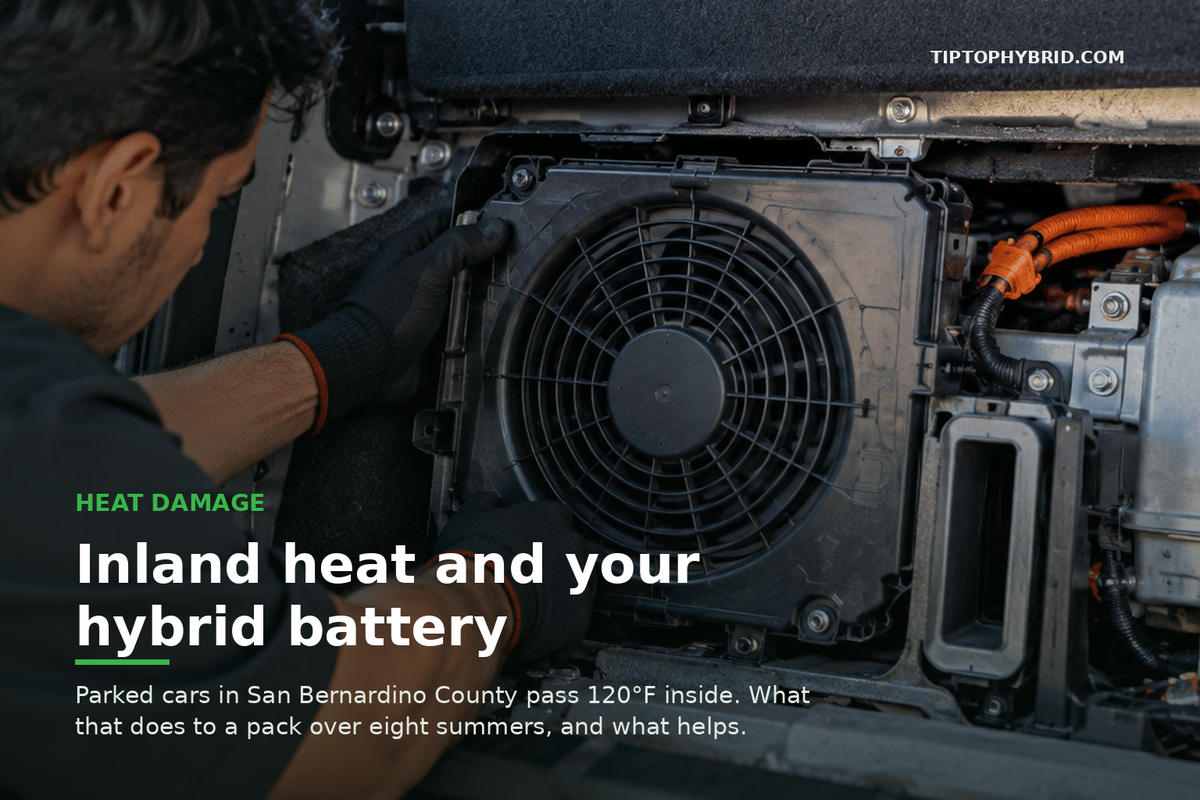
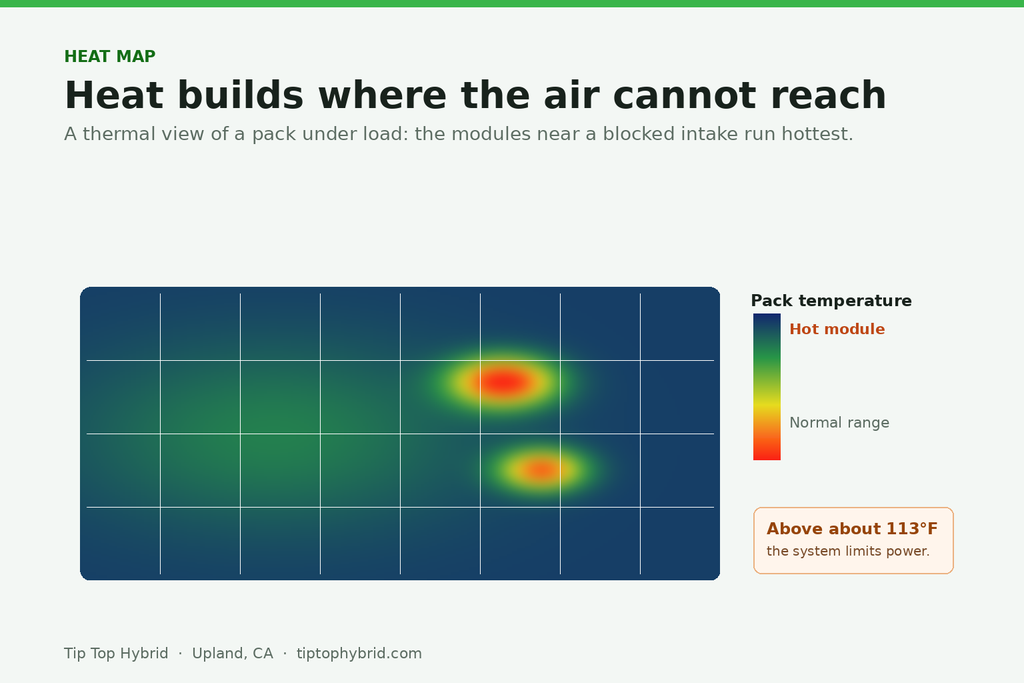
Yes. A car parked outside in Upland on a 105°F afternoon can push cabin air past 130°F, and the pack behind the rear seat soaks all of it up. Hybrid packs like roughly 68°F to 86°F. Cross about 113°F and the computer starts trimming electric assist to protect the cells.
Heat doesn't kill a pack in one afternoon. It shortens its life every summer, and the bill shows up years later as 38 mpg instead of 48.
How Hot Does the Pack Actually Get? Ambient, Cabin, Pack
Ambient temperature is the least useful number here. What matters is the air the pack breathes, and it comes from the cabin. Typical values for a dark car on a sunny inland afternoon:
| Where you measure | Typical reading | What it means for the pack |
|---|---|---|
| Shade, 100°F day | Cabin near ambient | The pack gets air it can use |
| Full sun, closed car, 100°F day | Cabin air 130–150°F | Every breath of cooling air is hotter than the pack |
| Asphalt surface in direct sun | 140–160°F | Heat soaks up through the floor |
| Pack at 68–86°F (20–30°C) | Comfort band | Full electric assist, normal fan speed |
| Pack at 100–113°F | Warm | Fan at high duty, assist starting to trim |
| Pack above roughly 113°F (45°C) | Hot | Power derate, engine forced on more often |
| Pack near 122°F and climbing | Protection territory | Assist cut, warning light likely |
Here's the trap. Once the cabin hits 140°F, the cooling system pumps 140°F air across a pack that wants 90°F. The fan runs harder and the pack still gets hotter. A hybrid parked in the sun all day starts every afternoon behind.
What Years of Heat Do to a Nickel-Metal Hydride or Lithium Pack
Heat accelerates every reaction inside a cell, including the ones that wear it out. Reaction rates double roughly every 18°F (10°C). A pack living 20°F hotter than another of the same age ages faster. Not double, but enough over a decade.
On nickel-metal hydride, heat shows up three ways. Electrolyte dries out. Internal resistance climbs, so the pack sags under load. Blocks drift apart, because hot middle modules age faster than cool outer ones. That drift is what eventually sets P0A80.
Lithium fails differently. Heat grows the passivation layer on the anode, consuming lithium and cutting capacity. High temperature plus high charge is the worst pair, which is why leaving a charged lithium pack in the sun is bad practice. Hybrids hold charge in a narrow band, so they're less exposed than a plug-in. Less exposed isn't immune.
Either way the damage is cumulative and invisible until it isn't. No pack announces that one summer cost it 4% of capacity. You find out years later, two bars down on a hill it used to ignore.
"Cooling Performance of the Hybrid Battery Is Low": What That Message Means
You'll see this phrasing on scan tools and hybrid apps that read live pack data. The exact wording varies by tool, and it's rarely a dashboard message, which is why people miss it.
The computer sets it when pack temperature rises faster than the cooling system can pull it down, or when the fan doesn't reach the speed it was told to reach. In plain terms, the pack is hotter than it should be for how hard the fan is working.
So it's usually airflow or the fan, not a dying pack. Chase it anyway, because a pack that runs hot for months ages faster. Clearing the code tells you nothing except that the light is off.
Five Reasons an Inland Empire Hybrid Runs Hot
Most common first:
1. A blocked intake behind the rear seat
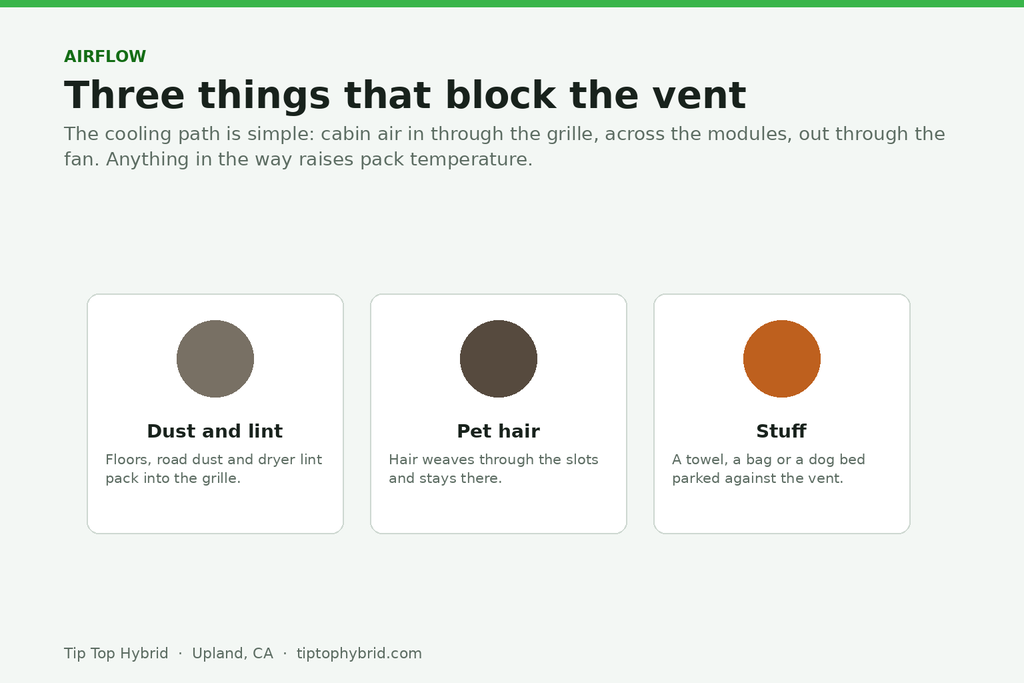
The pack breathes cabin air through a vent behind the rear seat. Dust, pet hair, a beach towel, a cargo mat slid too far back, a sunshade stuffed in the hatch. Ten years of Inland Empire grit packs a vent solid. It's the cheapest thing on this list to fix and the most damaging when ignored.
2. A fan that still spins but no longer moves air
A worn motor can sound fine and still deliver half the airflow it did new. Dirty blades move less air at the same speed. You'll hear it before you feel it. If noise is the symptom, we covered it in why the cooling fan runs loudly.
3. Stop-and-go on the 10 in August
Traffic does two things at once: no air moves over the car, and the pack keeps cycling every few hundred feet. The fan works at full command with nothing cool to work with. A 45-minute crawl from Ontario to Pomona on a 104°F afternoon is the worst duty cycle a hybrid battery sees all year.
4. Parked on asphalt from 8 to 5
A work lot is a heat soak. The car bakes nine hours, the cabin hits 140°F, and every drive starts from a bad place. Five days a week for eight summers and the numbers show up on a scan tool.
5. A sensor or damper fault that lies to the computer
Less common, harder to find. A sensor reading low makes the fan lazy. A stuck damper or wiring fault feeds the control system bad data, and it responds correctly to the wrong information. Diagnosis job, not a parts guess.
Five Warning Signs That Show Up Before a Code
The pack complains before the dashboard does:
- The fan keeps running after shutdown, or hits full speed on a mild day.
- Fuel economy drops 4 to 6 mpg and stays there, same commute, same tires.
- The gauge falls faster than it used to, especially on hills or with the AC on.
- A hot, dusty, faintly electrical smell from the rear seat after a long drive.
- Less pull in electric-only driving, or the engine kicking in earlier than it should.
One of those is a maybe. Three together in August is a pattern. If a red triangle joins them, read up on red triangle warning light causes before you keep driving.
What Actually Helps, Ranked by How Much It Helps
Most heat advice is an unordered list. This one is ranked, because the gap between first and fifth is large.
- Park in shade or a garage. A carport cuts cabin temperature by tens of degrees. If you do only one thing on this list, do this one.
- Keep the intake clear and vacuum it yearly. No luggage against the vent, no cargo mat over the grille, no dog bed behind the seat. Then actually clean it.
- Knock the cabin heat down first. Windows down for a minute, then AC on recirculate. It pulls the worst of the soaked air out before the pack breathes it.
- Go easy for five minutes after a hot soak. Hard acceleration out of a 140°F lot stacks load on a pack that's already hot.
- Service the cooling system before summer. A fan and filter check in April costs less than a pack in September.
None of this makes a hybrid immune to these summers. It buys years. For the non-heat habits, see how to extend the life of a hybrid car battery. Cooling-system anatomy and its effect on MPG live in the hybrid battery cooling system guide.
When Heat Damage Stops Being Maintenance and Becomes a Repair
Heat is maintenance until the numbers move. The line gets crossed by a persistent code, a red triangle that returns after clearing, a widening block spread, or a gauge that can't hold its place on a normal drive. Then you're managing a pack that lost capacity.
Heat damage is uneven. Middle modules cook first, so a pack with three tired blocks and eleven healthy ones is a repair candidate, not scrap. Worth knowing before you approve a quote.
California shops must give you a written estimate before work starts, and the Bureau of Automotive Repair spells out what it has to cover. Ask for block voltages alongside it. If a shop can't show the numbers, you're buying an opinion.
Where the Heat Hits Hardest Around Upland
Upland sits at the base of the foothills, and the heat here has a shape. The 10 through Montclair, Pomona and Ontario is a wide strip of asphalt with heavy truck traffic, several degrees hotter than the streets a mile north. Cars commuting that corridor daily see more heat cycles than cars that stay local.
The other pattern is parking. Many cars we see live outside, in carports off Foothill or in unshaded apartment lots in Montclair and Claremont. Those packs sit at cabin temperature every weekday afternoon. Not abuse. Just an inland summer on a car without a garage.
The Questions We Hear Every August
How hot is too hot for a hybrid battery?
The comfort band is roughly 68°F to 86°F, and most hybrids start limiting assist around 113°F. Above that, performance drops and wear speeds up. Short spikes are survivable. Weeks of it aren't free.
Does hot weather permanently damage a hybrid battery?
Over years, yes. Heat is cumulative: it dries out nickel-metal hydride electrolyte, raises resistance, and widens the gap between blocks. One hot week won't ruin a pack. Eight inland summers take a measurable bite.
What does "cooling performance of the hybrid battery is low" mean?
Pack temperature is rising faster than the fan can bring it down, or the fan isn't reaching commanded speed. Usually a blocked intake or a tired fan, not a failed pack. Check airflow before you price a battery.
Can a clogged fan or vent really cause overheating?
Yes, and it's the most common cause we find. The pack has no other way to shed heat. Restrict the air and temperature climbs on every drive, which is why a cleaning fixes cars that looked like they needed a battery.
Does parking in the shade really help?
It's the highest-value habit here. Shade can hold cabin temperature 30°F to 40°F below a sun-baked interior, and the pack breathes that air. It won't stop normal aging. It slows it, free, every day.
Get the Pack Checked Before Next Summer
If your hybrid ran hot this year, don't wait for July to learn what it cost. We test pack temperature, fan behaviour, airflow and block balance in one visit. We handle hybrid battery service in Upland for Toyota, Lexus, Honda and Ford hybrids.
Call 909-238-7028 or request a free estimate. Find us at 1894 W 9th St Ste B, Upland, CA 91786.
Tip Top Hybrid — hybrid battery repair and replacement in Upland, serving the Inland Empire.