
What a Hybrid Battery Health Test Measures, and What It Leaves Out
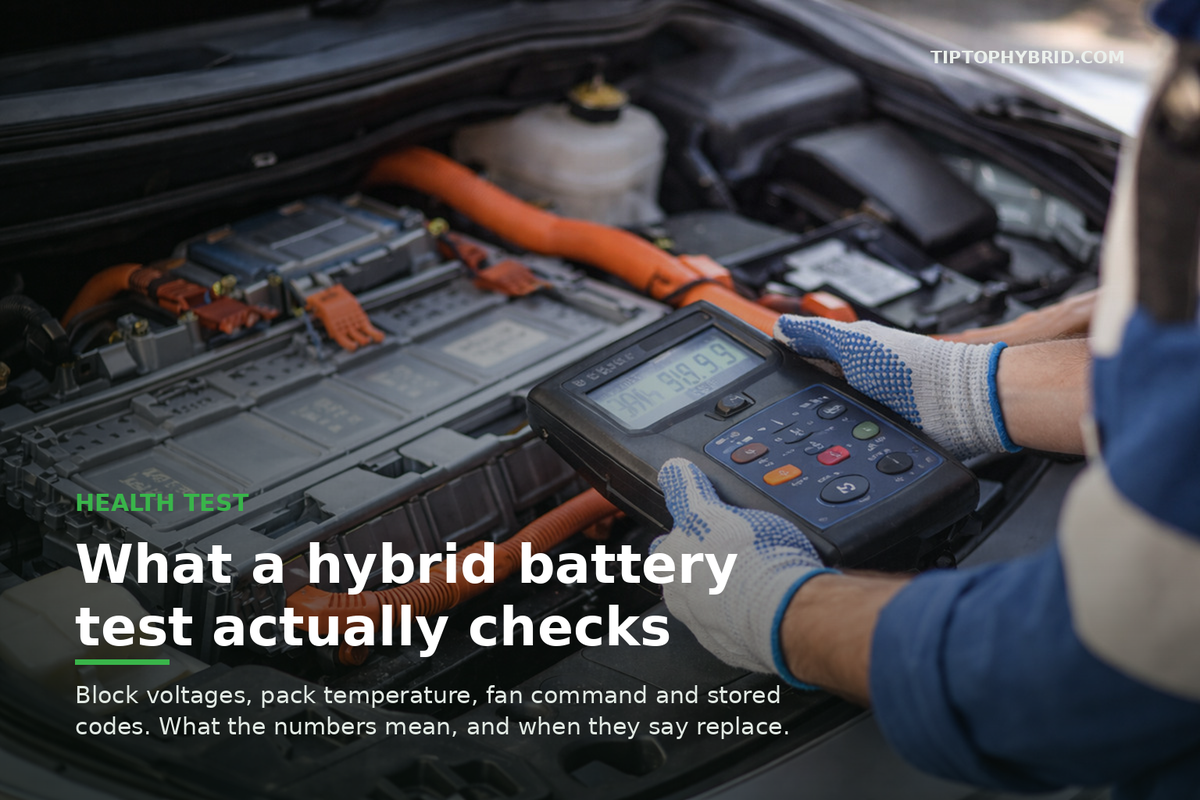
A hybrid battery health test reads the pack's live data: block voltages, temperature, fan behaviour, state of health and stored codes. It shows how balanced and how cool the pack runs today, not when it will fail. It measures condition and trend, which is what decides repair, replacement or nothing.
Most people book this test for one of two reasons: a light came on, or they're buying a used hybrid. Neither question gets answered by a five-minute load test at a parts store.
The Five Numbers We Read Before We Say Anything
Every pack we test gets the same five checks, in the same order. Skip one and the story falls apart.
Block voltage spread: what good looks like
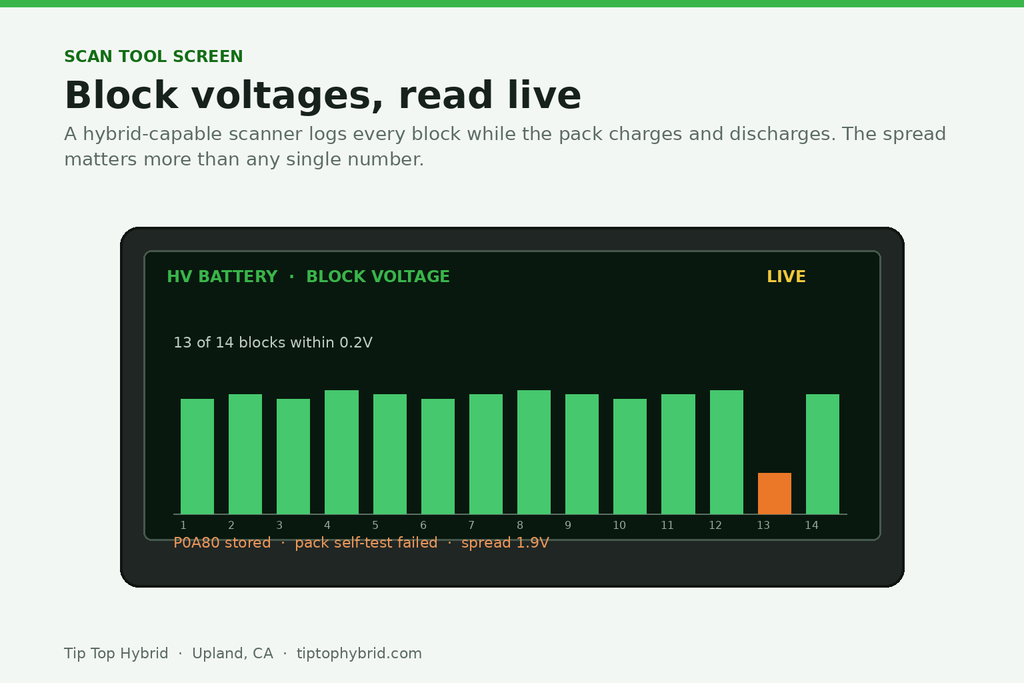
The pack is a long series string, so the weakest block sets the ceiling. A scan tool lists the blocks as a row of voltages. On a settled pack, a healthy Prius typically shows them within about 0.2 to 0.3 volts of each other.
Push past half a volt of spread and we hunt the outlier. That block drags the pack down, triggers P0A80 and makes the gauge plummet on a hill. It also means a module repair might fix the car for a fraction of a replacement. Spread decides which conversation we're having.
Battery temperature, and what the fan was told to do
Two temperatures matter: what the sensors report, and how hard the fan is working to hold them. A pack sitting 15°F to 20°F above cabin air with the fan at maximum means restricted airflow or a tired fan. A pack reading cool while the fan screams usually means a sensor is lying.
We compare pack temperature to intake temperature, then watch the fan duty cycle climb as the pack warms. If the fan goes to full and the temperature keeps rising, the problem is physical. Something is blocked, broken, or not moving air.
State of charge is not state of health
State of charge is the fuel gauge: how full the pack is right now. State of health is capacity: how much it can still hold compared with new. Drivers mix the two up constantly.
A car can show 60% charge and 62% health. The gauge looks normal and the pack is worn out. Most shops treat anything under about 70% health as a replacement conversation, and 70% to 80% as watch-it territory. The car estimates health from charge and discharge energy plus internal resistance, so read it as a trend, not a verdict. The DOE's hybrid technology overview explains how these packs store and release energy.
Stored codes: P0A80 and the ones hiding behind it
We scan every module, not just the hybrid ECU, and we read freeze frame data for each code. P0A80 says the pack failed a self-test. It does not say why. Behind it you'll often find a cooling fault, a temperature sensor code, or an inverter code that set first and got buried.
Pending and history codes matter as much as current ones. A code that set once in August and never returned tells a different story than one that resets every morning. That's why we clear, drive and re-scan instead of quoting a pack off a list. More on what the P0A80 code means if you already have one.
Cooling airflow and a dirty intake
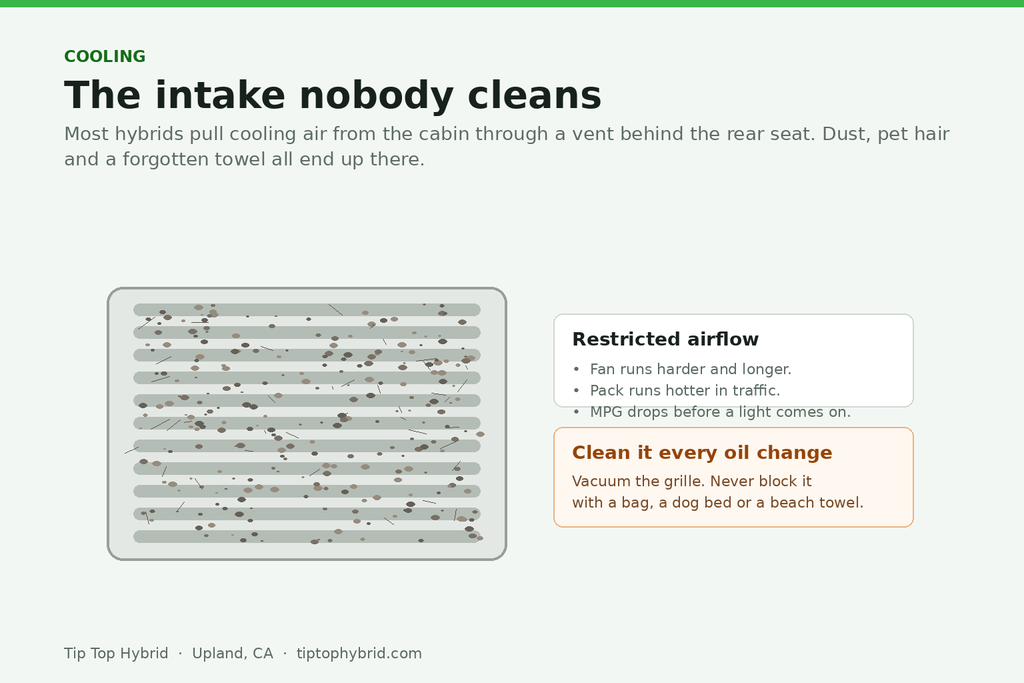
The check most tests skip, and the one that finds the cheapest fixes. Air comes from inside the cabin through a vent behind the rear seat or in the rear trim. Pet hair, dust, a cargo mat, a child seat wedged against the grille — all of it strangles airflow.
We pull the intake, look at the filter and the fan blades, and check that air actually moves where it should. A clogged intake on an otherwise healthy pack is a cleaning job, not a $4,000 job. The cooling system's job and why it wrecks MPG is covered properly in our hybrid battery cooling system guide.
What Happens in the Bay, Step by Step
The whole job runs 45 to 60 minutes on most Toyota and Lexus hybrids. The pack stays in the car. On some models the rear seat cushion comes out and goes straight back. We drive it only if we're chasing an intermittent fault.
- Interview and first scan, about 10 minutes. When did it start, what were you doing, what has already been replaced. Then a full code scan with freeze frames and the state-of-health read.
- Block voltages under load, about 20 minutes. We bring the pack to mid charge and watch the blocks while it works. A block that sags under load while reading fine at rest is the classic weak module.
- Thermal and airflow check, about 10 minutes. Temperature readings at the intake and the pack, a fan command sweep, and a look at the vent, filter and fan blades.
- Written summary, about 10 minutes. The five numbers, what they mean, and your options with prices. You leave with the readings, not just an opinion.
How Long Does It Take, and What Does It Cost in Upland?
Call for the current diagnostic fee. It depends on the model and on whether you want a full pre-purchase report rather than a symptom diagnosis, so a flat number on a web page would be wrong half the time.
For context, hybrid battery diagnostics in the US typically run $100 to $200 in 2026, and some shops credit part of it toward the repair. Ask before you book, wherever you take the car. Prices checked November 2026.
Plan for the car to sit an hour. A repair is a separate booking, usually a day. A replacement runs one to two days, because the pack gets sourced and the car gets re-tested.
Green, Amber, Red: How to Read Your Results
Most results land in three buckets. Here's what each one means in plain terms.
| Your readings | What it usually means | What to do next |
|---|---|---|
| Spread under 0.3V, health above 80%, no current codes | Green. The pack is doing its job. | Keep the intake clean, recheck in 12 months or at the next symptom |
| Spread 0.3–0.5V, health 70–80%, or a stored cooling code | Amber. Something is drifting, but it isn't failing yet. | Clean and service the cooling system, recheck in 3 to 6 months, start budgeting |
| Spread over 0.5V, health under 70%, or a current P0A80 | Red. The pack has failed a test or lost real capacity. | Module repair or pack replacement, and stop planning long trips until it's sorted |
Amber is the interesting bucket. A spread that grows from 0.2V to 0.5V over a year tells you more than any single test will. A pack that holds steady for two years is one you can stop worrying about.
Can a Health Test Tell You When the Battery Will Fail?
Not exactly. Anybody who tells you a laptop can date-stamp your pack's death is selling something.
What the test can do is real, though. It catches a pack that is already losing balance, running hot, or holding less than it should, usually months before the dashboard says anything. It separates a cooling problem from a cell problem, which is the difference between a cleaning and a replacement. And on a used car, it turns "seems fine" into a list of numbers.
What it can't do is predict an internal short. A block can fail in a pack that tested clean six weeks earlier. That's rare, and no scan tool sees it coming. Test twice, twelve months apart. Two tests show direction; one shows a snapshot.
If you want the long version of what wear looks like over years, our guide to how long a hybrid battery lasts covers the mileage and age patterns.
When Is It Worth Booking One?
Four situations, and only one of them involves a warning light.
- Before you buy a used hybrid. Private-party Prius, Camry Hybrid, Accord Hybrid, whatever it is. An hour of testing is cheap next to a pack you didn't budget for. Ask for the block voltages in writing.
- Any hybrid warning light that stays on. Especially a red triangle or "Check Hybrid System." Codes point at a system, not a part.
- MPG that has slipped and stayed slipped. A 5 mpg drop over a few months, with the same commute and the same tires, is worth a look.
- Before a hot summer, on an older car. A pack that's already marginal gets worse in July. Testing in spring gives you options.
Why Inland Empire Cars Test Differently
Two local patterns show up again and again. The first is dust. A car parked outside in Upland, Montclair or Pomona pulls grit and tree debris into the cooling intake all year, and a Santa Ana wind event packs it in faster. We've opened ten-year-old intakes that had never been touched.
The second is short-trip heat. Rancho Cucamonga to Pomona is fifteen minutes of stop-and-go with the AC on, which is hard on pack temperature and easy on nobody. Those cars often test in the low 70s on health with no warning light, just a quiet 4 mpg loss the owner blamed on the gas.
What Customers Ask Before They Book
What does a hybrid battery health test actually check?
Block voltages, pack and intake temperature, cooling fan behaviour, state of health, stored codes with freeze frames, and airflow at the intake. It's a data test, not a road test.
How long does the test take?
45 to 60 minutes on most hybrids, including the written summary. Pre-purchase inspections run longer if you want a full vehicle check too.
How much does a hybrid battery diagnostic cost?
Call us for the current fee, since it varies by model and by what you're asking for. Nationally, hybrid battery diagnostics typically run $100 to $200 in 2026, and some shops apply part of the fee to the repair.
Can a test predict exactly when my battery will fail?
No. It measures condition and trend. A clean test lowers the odds of a surprise, and a repeat test in a year shows which way the numbers are moving. Nobody can put a date on an internal short.
Should I get a battery test before buying a used hybrid?
Yes, and ask for the block voltages and state of health in writing. On a private-party car with no service history, an hour of testing is the cheapest insurance in the deal. If a seller refuses, that's your answer.
Book a Battery Test in Upland
You'll leave with the five numbers on paper and a straight answer: repair, replace, or nothing. If the pack is repairable, we say so — repair rather than replace is often right on a single weak block.
Call 909-238-7028 or book a diagnosis online. Tip Top Hybrid is at 1894 W 9th St Ste B, Upland, CA 91786.
Tip Top Hybrid — hybrid battery repair and replacement in Upland, serving the Inland Empire.